Lunar field guide
Five Moon craters to explore in Craterra
Craters give the lunar landscape its scale and identity. These five locations cover bright rays, dark lava floors, central peaks, northern and southern latitudes, and one of the largest recognizable crater interiors.
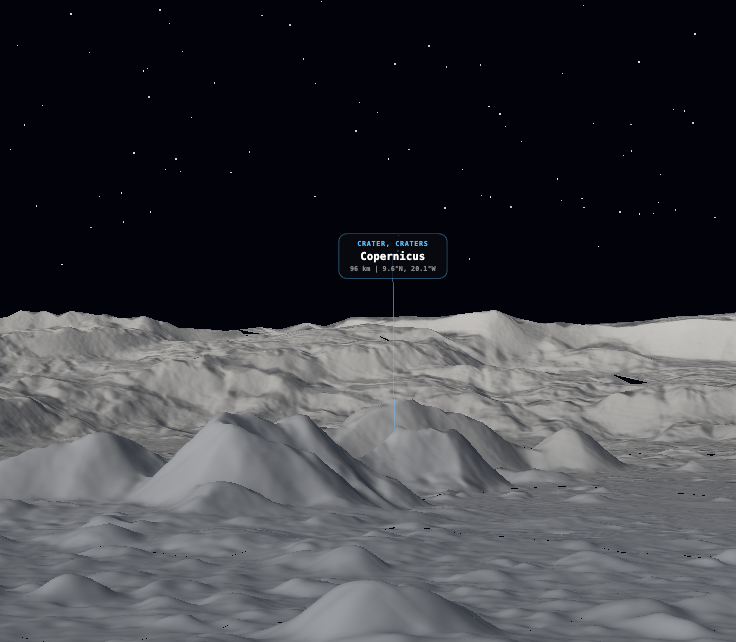
Open each crater at its coordinates
Copernicus
9.6° N, 20.1° W · 93 km. A prominent young crater with terraced walls, a central peak complex, and an immediately recognizable position on the near side.
Open in Craterra CRATERRA · 02Tycho
43.3° S, 11.2° W · 85 km. A bright southern crater whose ray system can be followed across a large part of the visible lunar surface.
Open in Craterra CRATERRA · 03Plato
51.6° N, 9.4° W · 101 km. An ancient, dark-floored crater beside Mare Imbrium, suited to a quieter northern location with a strong visual identity.
Open in Craterra CRATERRA · 04Aristarchus
23.7° N, 47.4° W · 40 km. One of the brightest formations on the Moon, set in a geologically varied plateau of rilles and volcanic features.
Open in Craterra CRATERRA · 05Clavius
58.4° S, 14.4° W · 225 km. A vast southern crater with a sweeping interior arc of smaller craters and a monumental sense of scale.
Open in CraterraWhat to compare
Diameter alone does not determine how a crater feels on the surface. Compare the height and complexity of the rim, the character of the floor, surrounding ejecta or rays, latitude, and nearby maria or mountain systems.
The global map is most useful as a first orientation. The surface view then reveals whether the location has the close-range character you want.
Names are navigation, coordinates are precision
A crater name describes a broad feature. A Craterra location link records a specific latitude and longitude inside or near that feature. Use both: the name gives human context, while the coordinates return you to the precise place.