Choosing a lunar location
How to choose your place on the Moon
There is no single best location on the Moon. A meaningful choice usually combines visual character, a recognizable name, surrounding terrain, and coordinates that make the place easy to return to and share.
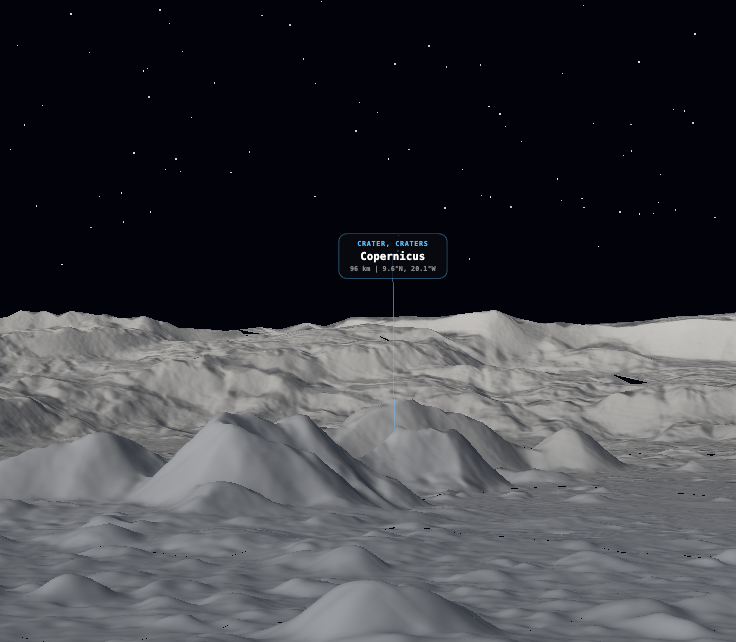
1. Begin with identity
Some locations are immediately recognizable: Copernicus for its terraced walls and central peaks, Tycho for its rays, Plato for its dark floor, and Aristarchus for its exceptional brightness. Other users may prefer a quieter unnamed area near a major landmark.
A named crater makes a location easy to explain. A less famous area can feel more personal. Both choices are visible through the same coordinate system.
2. Read the terrain around it
Look beyond the point at the center of the screen. Compare crater floors, rims, nearby slopes, maria, and mountain chains. A dramatic rim produces a different surface experience from a broad plain, even when the locations are close in latitude and longitude.
Move at more than one altitude before selecting. A site that reads clearly from the surface may blend into its surroundings from a high orbital view, while a major ray system may become more meaningful at larger scale.
3. Keep the coordinates
Craterra location links encode latitude and longitude so a view can be reopened. Coordinates also appear in plot and certificate records. They are the durable connection between the visual experience and the selected place.
- Copernicus
- 9.6N, 20.1W
- Tycho
- 43.3S, 11.2W
- Plato
- 51.6N, 9.4W
- Aristarchus
- 23.7N, 47.4W
4. Inspect before selecting
Open the candidate location in the simulator, travel around it, and compare at least one alternative. Craterra is designed so the decision happens on the surface rather than in a detached product list.